Indoor RF Tracking
Accurate indoor asset tracking where GPS falls short
Traditional GPS performs well outdoors but struggles inside buildings. Warehouses, production facilities, hospitals and distribution centres often block or weaken satellite signals, making reliable indoor positioning impossible.
TraceME RF Indoor Positioning provides an accurate and energy-efficient alternative. Using a network of fixed RF beacons and intelligent positioning algorithms, movable assets can be located in real time with an accuracy of up to 50 cm.
Whether you need to track tools, vehicles, containers or valuable equipment, TraceME delivers reliable indoor positioning while maintaining exceptionally low power consumption.
Why RF indoor positioning?
GPS depends on satellites that cannot reliably penetrate roofs, walls and other structures. Indoor positioning therefore requires a different approach.
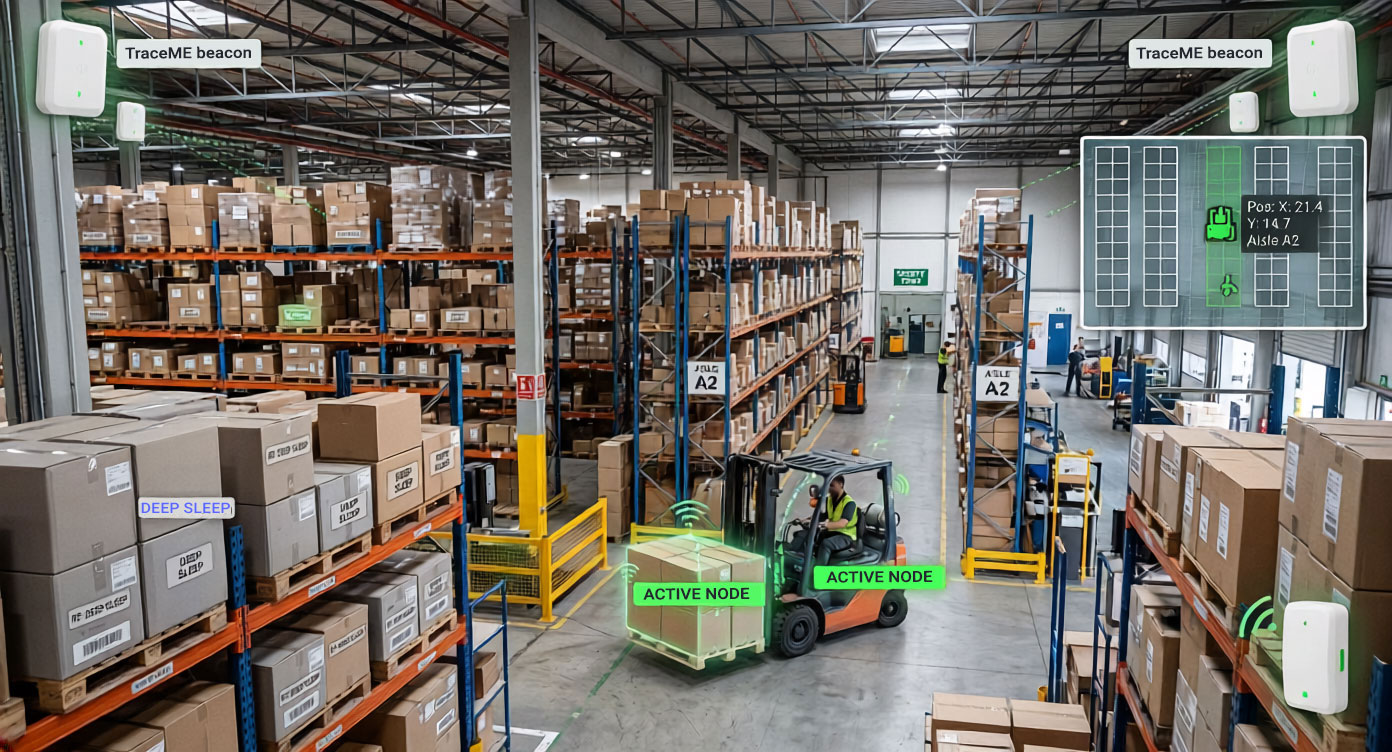
Instead of satellites, TraceME uses a network of fixed RF beacons installed throughout the building. Since the location of every beacon is known, the TraceME module can accurately determine its own position by analysing signals received from multiple beacons.
Advanced algorithms compensate for reflections and other environmental influences, ensuring stable positioning even in complex indoor environments.
How the system works
1. Fixed RF beacons create the positioning network
RF beacons are installed at strategic locations throughout the building. Each beacon continuously broadcasts its own position and communicates with the central server via the local network.
Together they create a positioning infrastructure that covers the complete indoor area.
2. The TraceME module listens continuously
Each asset is equipped with a TraceME module.
Rather than continuously transmitting radio signals, the module operates according to our Listen Before Talk principle. It continuously listens for nearby beacon signals while remaining in an ultra-low-power state.
This approach offers several important advantages:
- extremely low battery consumption
- minimal RF traffic
- increased network capacity
- improved resistance against RF detection
3. Motion activates positioning
Most tracked assets remain stationary for long periods.
An integrated 3-axis accelerometer continuously monitors movement while consuming virtually no power.
As soon as movement is detected, the module immediately wakes up and determines its position using signals from the surrounding RF beacons.
4. Position is calculated
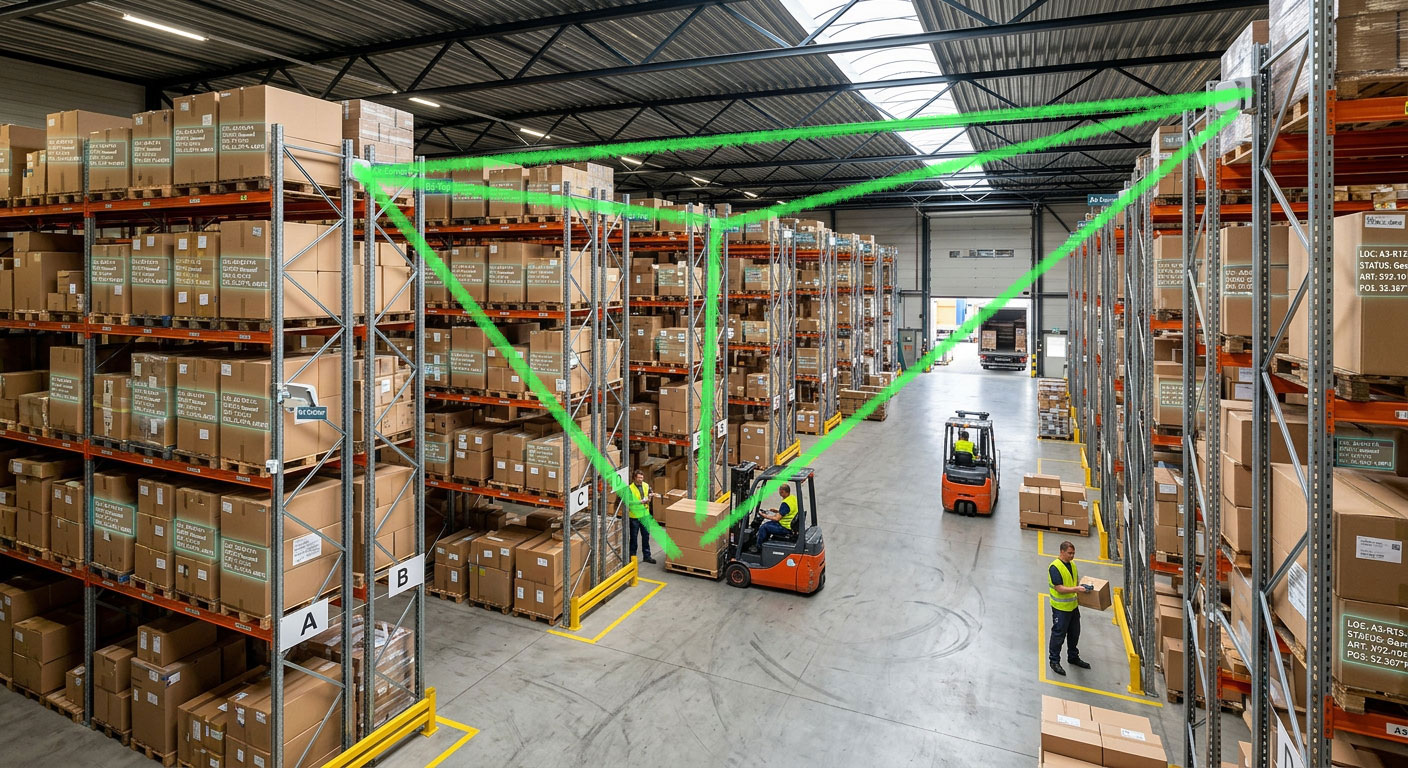
Using signals received from multiple beacons, the module calculates its location.
Intelligent positioning algorithms compensate for signal reflections, obstacles and changing environmental conditions, providing positioning accuracy of up to 50 cm, depending on the installation.
5. Position is reported
Once the position has been determined, the module transmits:
- current location
- battery status
- I/O status
- temperature (optional)
- additional sensor information
The central software immediately displays the updated asset position on the facility map.
6. Return to sleep
When movement stops, the final position is transmitted.
The module then automatically returns to its ultra-low-power sleep mode until movement is detected again.
This intelligent power management enables battery lifetimes of up to 15 years, depending on the application.
Key advantages
- Ultra-low power consumption
Motion-triggered positioning and intelligent sleep modes maximise battery lifetime while reducing maintenance. - High positioning accuracy
Accurate indoor positioning of up to 50 cm using advanced RF positioning algorithms. - Scalable architecture
Large numbers of assets can be tracked simultaneously thanks to minimal RF communication and efficient network design. - Secure proprietary communication
Encrypted RF communication protects location information and prevents unauthorised access. - Hybrid indoor & outdoor tracking
When an asset leaves the indoor RF network, TraceME modules can seamlessly switch to alternative positioning technologies such as GPS, cellular or optional satellite communication.
Smart features
Geofencing
Virtual zones can be defined within the facility.
Whenever an asset enters or leaves a predefined area, the system can automatically generate alarms, notifications or workflow actions.
Indoor to outdoor transition
If an asset leaves the indoor RF coverage, the module automatically recognises that it is outside the positioning network.
Depending on the module configuration, outdoor tracking can continue using:
- GPS
- Cellular networks
- LoRa
- Optional Iridium satellite communication
This enables uninterrupted tracking throughout the complete logistics chain.
Transport mode
Assets transported between facilities can remain traceable during transit.
Vehicles equipped with a mobile beacon can maintain communication with TraceME modules until they arrive at the next RF positioning network.
Typical applications
TraceME RF Indoor Positioning is suitable for a wide range of industries.
| Industry | Typical assets |
|---|---|
| Warehousing & Logistics | Pallets, containers, forklifts |
| Manufacturing | Tools, work-in-progress, equipment |
| Healthcare | Medical devices, hospital equipment |
| Security | High-value assets |
| Construction | Machines and equipment |
| Defence & Public Safety | Personnel and asset tracking |
| Sports & Events | Equipment and performance monitoring |
Designed for demanding environments
Warehouses, factories and industrial facilities present challenging RF conditions due to metal structures, machinery and signal reflections.
TraceME has been specifically designed for these environments. Intelligent positioning algorithms continuously compensate for changing conditions, ensuring reliable indoor positioning where conventional technologies often fail.
Suggested Indoor RF Tracking Hardware
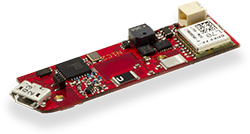
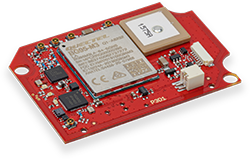
TM-3201/P3D2
Solar, Wi-Fi, BLE, LoRa, Sigfox, LTE-M
Solar and wireless power charging support
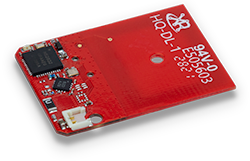
TM-3001/SR3V6
BLE, 13.56MHz NFC
Standby battery up to 15 years, Motion sensor
Need reliable indoor asset tracking?
Contact our specialists to discuss how TraceME RF Indoor Positioning can be integrated into your facility.
Contact Us